显示标签为“no-1chineselearning”的博文。显示所有博文

2012年2月24日星期五

Maijishang Grottos


The Maijishan Grottos are situated in the Maiji Mountain, southeast of Tianshui County in Gansu Province. The mountain, which is shaped like a haystack, gets its name from the Chinese for haystack, mai Construction of the Maijishan Grottos went on from the Northern Wei till the Qing (1644-1911) dynasties.
But because of earthquakes and erosion by wind and water, about one-third of the grottos have crumbled in ruins. only 194 grottos with about 7800 clay and stone statues and some 1300 square meters of murals are preserved. Clay statues in the Maijishan Grottos include round carvings, deep reliefs, paste carvings, and wall carvings. The round carvings are very vivid and full of interest; they range from the 16-meter big Buddha to a small 10cm sculpture. The Buddha statues in the Maijishan Grottos are humanized, making viewers feel familiar with them.

The longmen grottoes


The Longmen Grottoes are one of the finest examples of Chinese Buddhist art. Housing tens of thousands of statues of Buddha and his disciples, they are located 12 kilometres south of present day Luòyáng in Hénán province. The images, many once painted, were carved into caves excavated from the limestone cliffs of the Xiangshan and Longmenshan mountains, running east and west. The Yi River flows northward between them and the area used to be called Yique ("The Gate of the Yi River").The alternative name of "Dragon's Gate Grottoes" derives from the resemblance of the two hills that check the flow of the Yi River to the typical "Chinese gate towers" that once marked the entrance to Luoyang from the south.
There are as many as 100,000 statues within the 1,400 caves, ranging from an 1 inch (25 mm) to 57 feet (17 m) in height. The area also contains nearly 2,500 stelae and inscriptions, whence the name “Forest of Ancient Stelae", as well as over sixty Buddhist pagodas. Situated in a scenic natural environment, the caves were dug from a 1 kilometre stretch of cliff running along both banks of the river. 30% date from the Northern Wei Dynasty and 60% from the Tang, caves from other periods accounting for less than 10% of the total. Starting with the Northern Wei Dynasty in 493 AD, patrons and donors included emperors, Wu Zetian of the Tang dynasty, members of the royal family, other rich families, generals, and religious groups.
In 2000 the site was inscribed upon the UNESCO World Heritage List as “an outstanding manifestation of human artistic creativity,” for its perfection of an art form, and for its encapsulation of the cultural sophistication of Tang China.

2012年2月18日星期六

The yungang grottoes


The Yungang Grottoes are ancient Chinese Buddhist temple grottoes near the city of Datong in the province of Shanxi. They are excellent examples of rock-cut architecture .The site is located about 16 km south-west of the city of Datong, in the valley of the Shi Li river at the base of the Wuzhou Shan mountains.
They are an outstanding example of the Chinese stone carvings from the 5th and 6th centuries. All together the site is composed of 252 grottoes with more than 51,000 Buddha statues and statuettes. In 2001, the Yungang Grottoes were made a UNESCO World Heritage Site The Yungang Grottoes is considered by UNESCO a "masterpiece of early Chinese Buddhist cave art... [and] ...represent the successful fusion of Buddhist religious symbolic art from south and central Asia with Chinese cultural traditions, starting in the 5th century CE under Imperial auspices."
More information about chinese culture ,please check:www.no-1chineselearning.com

2012年2月12日星期日

The Chinese Grammar— The Pivotal Sentence

汉语语法——兼语句  The Pivotal Sentence
兼语句(the pivotal sentence):让某人做某事(ask somebody to do something
1)兼语句的语序:The grammatical order for pivotal sentence
主语+动词1(叫//请)+兼语(宾语/主语)+动词2+宾语
S   + V1 (叫//请) +pivotal wordO/S+V2  +O

主语(S
动词1 V1
宾语/主语(O/S)
动词2  (V2)
宾语  (O)
你们
谈谈
自己的爱好
老师
大家
回答
问题
公司
中国
想请
一个老师
书法

兼语句的前一个动词常常是“请”、“叫”、“让”、“派”等有使令意义的动词,而它的宾语又是第二个动词的主语。(The first verb in a pivotal sentence is often a causative verb,including “请”、“叫”、“让”、“派”.The object of the first verb is at the same time the subject of the second verb.

Musical Instrument----pipa


    The pipa is a four-stringed Chinese musical instrument, belonging to the plucked category of instruments. Sometimes called the Chinese lute, the instrument has a pear-shaped wooden body with a varying number of frets ranging from 12–26. Another Chinese 4 string plucked lute is the liuqin, which looks like a smaller version of the pipa.
The pipa is one of the most popular Chinese instruments and has been played for almost two thousand years in China. Several related instruments in East and Southeast Asia are derived from the pipa; these include the Japanese biwa, the Vietnamese đàn t, and the Korean bipa. The Korean instrument is the only one of the three that is no longer used; examples survive in museums, but attempts to revive that instrument failed.

2012年2月5日星期日

Jin Business


Chinese Culture--Jin Business


Jin Business or Shanxi Business dated back to the Zhou Dynasty, and developed in the Tang Dynasty and trived in the Ming Dynasty and reached its peak in the Qing Dynasty.

(一)Origination of Shanxi business lies in three factors.

1)      Shanxi was rich in various resources. They transported the natural resources to other places and sold them to the local people.

2)      Shanxi was poor in the farming land. People had to make a living by business. For example, Qiao Family in Qi County were forced to leave hometown at the beginning of business. The founder was just an apprentice worker far away in Inner Mongolia. After the family had earned some money they began to mak Doufu, a kind of popular food from beans. And another rich family Qu Family originated with peddlers, and another rich family Wang Family originated selling Doufu, too. Chang Family originated as a walking businessman of groceries.


3)      Shanxi was located with military superiority. Inner Mongolia needed food, cloth and daily goods from inner land, and inner land needed horses from Inner Mongolia. Shanxi was just at the place to exchange for both sides.

(二)Jin Business Activities
Jin Business activities usually included three parts:

1)      selling the salt, iron, wheat, cotton, leather, wood, tobacco to the south which Shanxi was rich in;

2)      buying silk, tea, rice from the south;

3) selling those from the south to the northwest of China, Mongolia and Russia.

Introduction of Chinese Business


China is an ethnically and culturally diverse country. Its dominant cultural tradition has been heavily influenced by Confucianism and Daoism.

The idea of Righteousness of Confucianism dominated the Chinese business. And the farming economy was the mainstream in the development of Chinese business.

Chinese merchants, Chinese business and Chinese business culture originated in the central plain. It is proved that the character “”was the name of a primitive tribe in the south of Shangqiu(商丘) of Henan Province. Wang Hai(王亥), the forefather of Chinese business, was the fourth genenration of the tribe. He was the first to carry goods by cow-cart for business in the Shang Dynasty. Thus those engaged in business were called “商人”.

Zi Gong(自贡), one of Confucian students, born in Shandong, was good at business besides politics. Fan Li(范蠡), Sage of Chinese business, was a Nanyang native. He switched from the royal court to business. In the West Zhou there appeared the first professional merchants in Luoyang(洛阳)。 In the Spring and Autumn and Warring Period Shangqiu hand the first institute to collect the tariff. The first international big city was Kaifeng (开封)in the Song Dynasty, with a population of more than 150 million, vividly described in the Riverside Scene at Qingmng(清明上河图)by Zhang Zeduan.

It is generally accepted that Chinese business went through three stages: the Qin and Han Dynasties; the Tang and Song Dynasties and the Ming and Qing Dynasties.

However, Chinese business hasn’t developed as the western business. One factor is that Chinese business is typical of farming economy. Large land and rich resources surply enough to the people. Farming civilization is a conservative, stable and peaceful life style. The idea “ Put farming before business” restrains the development of business. The other factor is the influence of Confucianism. The idea “Learn and learn best and then be officials” strengthens the central government but weakens the business. The brilliant learners refuse to enter the business.

However, there are still some clans like the Kang Family in Gongyi(巩义)in the Qing Dynasty who created the business myths “ having remained to be rich more than 20 generations and to be successful more than 400 years”. The business culture in the central plain plays an important role in the Chinese culture.

Chinese Business has some typical ideas:
2)      Make money with unexpected ideas. (奇谋生财)
3)      Put farming before business. (重农轻商)
4)      Put righteousness before profit. (重义轻利)
5)      Victory lies in the awareness of a place, money comes from the selection of the region. (知地取胜,择地生财)
6)      Buy in when price is low, and sell out when price is high. (时贱而买,时贵而卖)
7)      The beginning can predict the ending, the little can show the great. (见端知末,见微知著)
8)      More sale at little profit. (薄利多销)
9)      Walk on land with a mind to prepare a boat, sail in water with an intent to buy a car.(旱则知舟,水则资车)
10)  Make money by business, and keep the business with money. (以商致财,用财守本)

2012年2月4日星期六

存现句(the existence-emergence sentence)


所谓存现句,表达的是人或事物的存在和出现(An existence-emergence sentence is indicating the existence and emergence of someone or something)。


存现句的句型结构(structure):


 处所词      动词      助词/补语      名词

Location word +    verb   + particle/complement +  noun


如:   楼下                                   一个人。

       前面                     过来            一辆车。

       树上                                   很多红枣。


在这个语法中,要特别注意句子最后的“名词”,它是“一个人”、“ 一辆车”、“ 很多红枣”……,这些宾语都是不确指的(indefinite)。所以,我们不能说:楼上下来了老师。

An existence-emergence sentence is usually used to describe an objective entity. The object in the sentence is indefinite. Therefore, we cannot say: 楼上下来了老师。


现在,我们来看图练习一下儿:


答案如下: ①书柜里摆着很多书。

墙上挂着很多照片。

树上停着一只鸟。


2012年2月3日星期五

Musical Instrument----er hu


Chinese Culture--Musical Instrument----er hu

The erhu  is a two-stringed bowed musical instrument, more specifically a spike fiddle, which may also be called a "southern fiddle", and sometimes known in the Western world as the "Chinese violin" or a "Chinese two-stringed fiddle". It is used as a solo instrument as well as in small ensembles and large orchestras. It is the most popular of the huqin family of traditional bowed string instruments used by various ethnic groups of China . A very versatile instrument, the erhu is 
used in both traditional and contemporary music arrangements, such as in pop, rock, jazz, etc.

The erhu consists of a long vertical stick-like neck, at the top of which are two large tuning pegs, and at the bottom is a small resonator body (sound box) which is covered with python skin on the front (playing) end. Two strings are attached from the pegs to the base, and a small loop of string (qian jin) placed around the neck and strings acting as a nut pulls the strings towards the skin, holding a small wooden bridge in place.


Musical Instrument----di zi


Chinese Culture--Musical Instrument----di zi

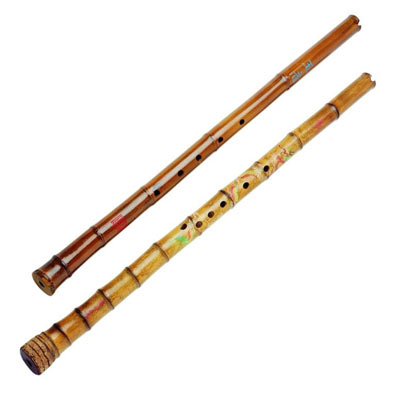
The dizi  is a Chinese transverse flute. It is also sometimes known as the di  or hengdi, and has varieties including the qudi and bangdi.
These names are likely to have multiple spellings, too, depending on the transliteration used to convert from Chinese names. Nonetheless, dizi seems to be the most common name used in the West.
The dizi is a major Chinese musical instrument, and is widely used in many genres of Chinese folk music, as well as Chinese opera, and the modern Chinese orchestra. Traditionally, the dizi has also been popular among the Chinese common people, and it is simple to make and easy to carry.
Most dizi are made of bamboo, which explains why dizi are sometimes known by simple names such as Chinese bamboo flute. However, "bamboo" is perhaps more of a Chinese instrument classification like "woodwind" in the West. Northern Chinese dizi are made from purple or violet bamboo, while dizi made in Suzhou and Hangzhou are made from white bamboo. Dizi produced in southern Chinese regions such as Chaozhou are often made of very slender, lightweight, light-colored bamboo and are much quieter in tone.
Although bamboo is the common material for the dizi, it is also possible to find dizi made from other kinds of wood, or even from stone. Jade dizi  are popular among both collectors interested in their beauty, and among professional players who seek an instrument with looks to match the quality of their renditions; however, jade may not be the best material for dizi since, as with metal, jade may not be as tonally responsive as bamboo, which is more resonant.
The dizi is not the only bamboo flute of China, although it is certainly distinctive. Other Chinese bamboo wind instruments include the vertical end-blown xiao, the guanzi (double reed), the koudi, and the bawu.