显示标签为“chinese instrument”的博文。显示所有博文

2012年2月12日星期日

Musical Instrument----gu zheng

The gu zheng  also called zheng is a Chinese plucked zither. It has 18-23 or more strings and movable bridges.The guzheng is the ancestor of several Asian zither instruments, such as the Japanese koto, the Mongolian yatga, the Korean gayageum, and the Vietnamese đàn tranh. The guzheng should not be confused with the guqin (another ancient Chinese zither without bridges).
The early types of guzheng emerged during the Warring States Period. It was largely influenced by the se, a plucked stringed instrument. It became prominent during the Qin period, and by the Tang Dynasty, the guzheng was arguably the most commonly played instrument in China.
There are many techniques used in the playing of the guzheng, including basic plucking actions (right or both hands) at the right portion and pressing actions at the left portion (by the left hand to produce pitch ornamentations and vibrato) as well as tremolo (right hand). These techniques of playing the guzheng can create sounds that can evoke the sense of a cascading waterfall, thunder, horses' hooves, and even the scenic countryside. Plucking is done mainly by the right hand with four plectra (picks) attached to the fingers.

Musical Instrument----pipa


    The pipa is a four-stringed Chinese musical instrument, belonging to the plucked category of instruments. Sometimes called the Chinese lute, the instrument has a pear-shaped wooden body with a varying number of frets ranging from 12–26. Another Chinese 4 string plucked lute is the liuqin, which looks like a smaller version of the pipa.
The pipa is one of the most popular Chinese instruments and has been played for almost two thousand years in China. Several related instruments in East and Southeast Asia are derived from the pipa; these include the Japanese biwa, the Vietnamese đàn t, and the Korean bipa. The Korean instrument is the only one of the three that is no longer used; examples survive in museums, but attempts to revive that instrument failed.

2012年2月3日星期五

Musical Instrument----er hu


Chinese Culture--Musical Instrument----er hu

The erhu  is a two-stringed bowed musical instrument, more specifically a spike fiddle, which may also be called a "southern fiddle", and sometimes known in the Western world as the "Chinese violin" or a "Chinese two-stringed fiddle". It is used as a solo instrument as well as in small ensembles and large orchestras. It is the most popular of the huqin family of traditional bowed string instruments used by various ethnic groups of China . A very versatile instrument, the erhu is 
used in both traditional and contemporary music arrangements, such as in pop, rock, jazz, etc.

The erhu consists of a long vertical stick-like neck, at the top of which are two large tuning pegs, and at the bottom is a small resonator body (sound box) which is covered with python skin on the front (playing) end. Two strings are attached from the pegs to the base, and a small loop of string (qian jin) placed around the neck and strings acting as a nut pulls the strings towards the skin, holding a small wooden bridge in place.


Musical Instrument----di zi


Chinese Culture--Musical Instrument----di zi

The dizi  is a Chinese transverse flute. It is also sometimes known as the di  or hengdi, and has varieties including the qudi and bangdi.
These names are likely to have multiple spellings, too, depending on the transliteration used to convert from Chinese names. Nonetheless, dizi seems to be the most common name used in the West.
The dizi is a major Chinese musical instrument, and is widely used in many genres of Chinese folk music, as well as Chinese opera, and the modern Chinese orchestra. Traditionally, the dizi has also been popular among the Chinese common people, and it is simple to make and easy to carry.
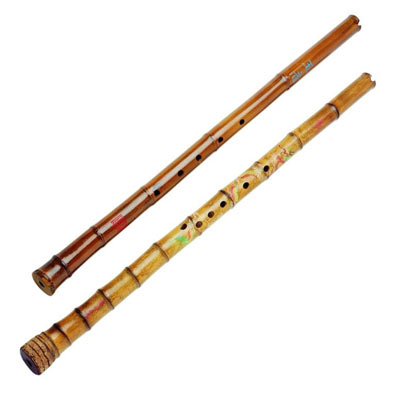
Most dizi are made of bamboo, which explains why dizi are sometimes known by simple names such as Chinese bamboo flute. However, "bamboo" is perhaps more of a Chinese instrument classification like "woodwind" in the West. Northern Chinese dizi are made from purple or violet bamboo, while dizi made in Suzhou and Hangzhou are made from white bamboo. Dizi produced in southern Chinese regions such as Chaozhou are often made of very slender, lightweight, light-colored bamboo and are much quieter in tone.
Although bamboo is the common material for the dizi, it is also possible to find dizi made from other kinds of wood, or even from stone. Jade dizi  are popular among both collectors interested in their beauty, and among professional players who seek an instrument with looks to match the quality of their renditions; however, jade may not be the best material for dizi since, as with metal, jade may not be as tonally responsive as bamboo, which is more resonant.
The dizi is not the only bamboo flute of China, although it is certainly distinctive. Other Chinese bamboo wind instruments include the vertical end-blown xiao, the guanzi (double reed), the koudi, and the bawu.